Saturday, 23 November 2019

Stalybridge Celtic vs. Buxton

Aside from having a football team, most towns in the country will have something notable about it that provides some riveting conversation between you and someone from there (whilst you’re on holiday in Benidorm or wherever). It could be a trade they’re famous for, a gruesome moment in history, a celebrity who’s from there – perhaps their football club reflects the town’s notability in some way. 

For us groundhoppers, the opportunity to visit new grounds in unfamiliar towns allows us to immerse ourselves in these facts, to learn more about them and even join in with whatever it is. This is why I’m in Stalybridge this afternoon – and it was an absolute pleasure to arrange. I’m off to see Stalybridge Celtic in Northern Premier League action against Buxton – and to visit the pub with the longest name in the UK for a pint or six on a bitter Saturday in late-November. 

Yes, The Old Thirteenth Cheshire Astley Volunteer Rifleman Corps Inn being the longest pub name in the UK is the notable fact that Stalybridge should be famous for! Located close to the railway station (turn right, walk under the bridge, you can see the massive sign right away), the pub isn’t actually the first version of The Rifleman. The original, which held the Guinness World Record, closed in late-2015.

The Old Thirteenth Cheshire Astley Volunteer Rifleman Corps Inn, Stalybridge

Originally named ‘The New Inn’, it first changed to ‘The Thirteenth Cheshire Rifleman Inn’  – this earned it a place in the first edition of The Guinness Book of Records in 1951 as ‘the pub with the longest name’. It seems that they were involved in a tit-for-tat war with other lengthy-named pubs (such as The London, Chatham and Dover Railway Tavern, and the Ferret and Firkin in the Balloon Up The Creek, both in London) – the extra words added to the Rifleman name over the years saw the Cheshire pub grab the title back.

After securing a premises to open a new pub earlier this year, landlady, Sarah Farrer-Baxter, thought long-and-hard about a name. By chance, she was well acquainted with The Rifleman’s former owners who on hearing the news, offered her the use of the name in order to keep it (and Stalybridge) on the map. Whilst delighted with the offer, Sarah indicated that reality hurt a little bit when it came to paying for the lettering!

It’s a fantastic story, something that is so quintessentially British; a pub in a provincial town having to battle the big city for the honour of having the longest name, just to create some notability for their community. Thinking about it, there could be a good TV drama made from two pubs trying to outdo each other over seemingly trifling issues as ‘having the longest name’. As long as there’s a decent script, mind (call me, producers).

Brilliantly, as I walk into the pub at around 1.30 pm, there’s only one other customer in! Although they have a decent range of premium lagers on, there’s nothing in the way of real or craft ales (that I can see – apologies if there were) for us beer ponces to get excited about, so I plump for a pint of Amstel. It’s a smart, well-lit place but it doesn’t feel like a traditional pub – more of a modern ‘bar’ with its bright walls, lighting and second floor with a swirly staircase.

The lad who’s serving is very friendly though, pub name emblazoned on his back, as he’s clearing some glasses away, he apologises for getting in the way of viewing of the pub telly – which he didn’t. As I’m watching the end of the West Ham-Tottenham game (Jose Mourinho’s first game in charge of Spurs – which they win 3-2), the place fills up nicely; there are about 10 people in as I leave just after 2 pm. To sum up; nice place, decent beers, friendly staff, good-sized tellies to watch sport, just don’t expect a traditional pub experience.

Bower Fold, Stalybridge Celtic F.C

Aside from pubs, the other notable thing about Stalybridge is the football club. Formed in 1909 (although there’s some circumstantial evidence that it may have been formed in 1906), the club’s heyday was in the 1920s when for two seasons, they were members of The Football League having formed the Third Division North with 19 other sides.

They had a great first season – finishing 7th in a league won by near neighbours, Stockport County. Despite finishing 11th the season after, the club resigned citing that they ‘couldn’t get sufficient support to justify a Football League side’ – which sounds odd, considering their average attendance of 5,400 was some 2,000 more than Rochdale, who finished a place below them. Was this a ‘sliding doors’ moment? Rochdale have stayed in The Football League ever since and currently ply their trade in League One.

After spending the majority of their existence knocking about the non-league pyramid, Stalybridge are currently battling at the top end of the Northern Premier League (Premier Division) table; holding onto the final play-off place. Coached by former Coventry, Wigan and Tranmere striker, Simon Haworth (scorer of many a great goal, including a particular favourite of mine at the old Wembley – see below), the Welsh international is carving out a decent non-league managerial career after spells at Eagley and Clitheroe a level or two below – so I’m interested in seeing how he’s getting on.


The club’s ground, Bower Fold, is located just over a mile from the town centre and has a capacity for around 6,000 spectators. The record attendance for a match involving Stalybridge was when 9.753 rocked up to see them in FA Cup first round replay action in January 1923, as they lost 2-0 against West Bromwich Albion. In more recent times, a crowd of 3,312 attended a second round FA Cup tie against Football League Third Division Chester City in 1999. Despite Andy Scott’s extraordinary goal (see the highlights below, it’s well worth it), Chester grew into the game and scored twice without reply to send them into the third round – where they faced Manchester City (then playing in the First Division).


The record attendance at Bower Fold, however, is believed to be as many as 10,300 when the famous women’s side, Dick, Kerr Ladies beat a ‘Rest of Lancashire XI’ 10-0 in 1921, raising around £600 (£29.000 in 2018, when adjusted for inflation) in aid of the local hospital. I say the crowd was ‘believed’ to be that many, as in those days, they could never be sure – some say the attendance could have been anywhere between 12-14,000). What we do know for a fact, is that Bower Fold is the only football ground in the country where the pitch apparently faces a perfect north.

Whilst researching the club (seeing if the game was going ahead, in truth) I see that they put out a plea for supporters to attend the game in big numbers, as they’re struggling for money – although I’d imagine most clubs at these levels are struggling, Stalybridge not having a home game in the league since the 12th October hasn’t helped matters. The press release, urging people to attend, encouraged attendees to also indulge in a pint. So naturally, I did.

Passing through the turnstile (£10 entry), I immediately catch sight of the supporters club straight ahead. Inside, it looks a bit swanky; it looks and feels more like a wedding reception venue with its wide-open spaces, smart seating, vast white walls and one-or-two ornate decorations. I indulge in a pint of Kronenberg, poured into a doubled-up plastic container and sashayed outside with it, giggling to myself that I’m allowed to drink this pint of lager by the side of the pitch – the novelty still hasn’t worn off. The weather outside even cools my pint for me as I stand behind the goal, waiting for the game to start.
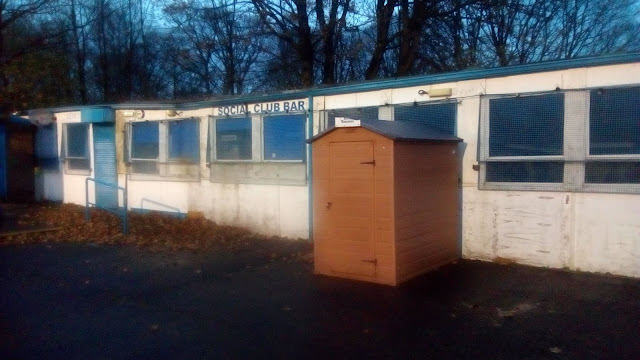
The mascot badger's shed at Bower Fold, Stalybridge

As I’m stood there, a bipedal badger walks past, handing out sweets to several kids who have been running around the terrace (as if they need more sugar!). What happened next took me by surprise – the badger walked to a shed, opened the door, ducked in and locked it. What’s going on here? It’s then I see that the shed is positioned in front of what (I assume) is the club’s old supporters club – the prefab building is locked, looking a little shabby and (the big giveaway) it has ‘Social Club Bar’ written on it. There’ve certainly upgraded with the wedding venue they’ve got now, anyway. A few minutes after the badger locked the door of the shed, it swings open to reveal a woman, a human woman – what’s she done with the badger?

Instead of reporting a possible badger murder to the police, I settle down to watch the match – supping my pint in the roofed terrace behind the goal. The home side make a decent start; passing the ball about nicely, looking for space in the Buxton defence – their first opportunity arriving courtesy of a shot-on-the turn that just cleared the crossbar. 10 minutes in, Ross Dent is the recipient of some more tidy play; he sneaks into the penalty area before opening out his body (not literally – it means 'turning your body into a comfortable position’) and guiding a centred-ball into the top corner of the net. Brilliant finish – one that certainly warms up the crowd around me, as the temperature continues to drop.

Buxton immediately try to put some pressure on their hosts and without a couple of timely interceptions at the back, they could have grabbed an equaliser. Stalybridge (or ‘Bridge’ as people around me are shouting) ride it out and could have even been two-ahead just before half-time as a volley-whilst-falling-on-your-arse (okay, an ‘acrobatic’ volley) smashed the crossbar and bounced away.

Half-time is spent in the wedding venue, as I sup on another cold pint to warm myself up (!) Early in the second half, Bridge do get their deserved second goal as Darius Osei seizes upon a loose ball in the area, turns and fires it into the back of the net. It’s a good job they have online match reports and videos – when it went in, I was finishing off my Kronie in the bar. Whoops!

I transfer myself to The Lord Tom Pendry Stand for the second half – named after the town’s former long-serving MP, this is the newest stand at the ground (built in 2004) and has over 650 seats. The main stand opposite has room for just over 700 people and was completed in 1996. Part of the reason why I chose to sit down for the second half was to get a different perspective of the match, the other because the regular supporters had moved down to the end where I was to watch their side attack the goal (so I lost my spot, due to babysitting a Kronie) and the final reason, was because it was colder than a White Walker’s heart now!

The -23 temperature (at least) didn’t bother the players much, as Bridge continued to control the game and eke out opportunities; a goal was ruled out for offside and Dent nearly bagged a second as his header was bound for the goal if not for the intervention of the visiting goalkeeper. A late chance sees a Bridge player go clear of the defence, but his chip over the keeper was just-about cleared off the line.

Stalybridge Celtic vs. Buxton

It finishes as a fully-deserved 2-0 win for the home side – Buxton unable to lay a glove on their opponents for the vast majority of the match. This win keeps Stalybridge in 5th, 7 points from top and automatic promotion. The crowd was announced as being 423 – which is up by 131 from their last home match in the league. Good news all round for the club, then!

I’m off back down to the town centre for a few more scoops – first stop is the Wetherspoons for some generic fish and chips. I then make a point of visiting ‘Bridge Beers’, which is a bottle shop and craft ale bar. The owner is friendly enough, guides me through the beers that were on tap – I have a pint of the pale ale Odin by Brightside brewery. I must say that I love a nice pale, hoppy blonde...ale. There’s a great array of bottles on sale behind me, but I decide to move on – 10 yards down the street to another real ale bar, The Craft Pint. This place is a bit more 'happening', as I walk in, I nearly bump into two greyhounds who are supping out of a bowl (water, before you worry – unless it was vodka?). My pint of choice here is ‘Deception’ by Abbeydale – sounds more like perfume than a 4.1% pale ale, but it’s something that I wouldn't mind wearing again.

Now there’s one fact about Stalybridge that I’ve left out until now (two actually, we’ll get to the next one in a minute) – not only does the town boast the pub with the longest name, It has the pub with the SHORTEST name too, located next-door-but one to the Rifleman! The pub is called ‘Q’ (technically it’s called ‘The Q Inn’, so it leaves it open for usurpers to steal the crown), and it’s fantastic. As soon as I walk in, the ‘traditional’ pub fixtures and fittings soak into your eyes, it’s tightly built, there’s a fire roaring and they have real ales on tap – the only thing that’s missing is a dog scampering around! I get a pint of their house beer ('Q Ale' - a 3.8% golden ale), which goes down rather nicely.

I round the day off with a visit to the Buffet Bar – the other attraction to Stalybridge that I haven’t mentioned. Apparently, this is one of very few remaining 'refreshment rooms' in the country and now mostly houses a real ale emporium in its narrow but long structure. With 20 minutes until I need to catch the train, I decide to grab a swift cider – but I didn’t account for the rowdiness of the lads, lads, lads that frequent train stations at 8 pm on a Saturday evening.

Buffet Bar at Stalybridge Station
Now, think about the penultimate scene in Brief Encounter. Imagine if Dolly Messiter was pissed on craft cider, unknowingly costing the two philanderers (which is ultimately what they were – Fred was a lovely husband, an absolute innocent who deserved better), their final moment of love. Well, that’s exactly what it was like, as the lads were ‘having the banter’ right in front of the bar, slowing down the queuing, preventing me from a treasured juicy delight.

However, unlike the doomed ‘couple’ in the film, I managed to shake off these Dollies, squeeze myself near the bar, get my pint and have it supped in time for the train. In other words, the refreshment room at Stalybridge is best visited on a weekday.

I’m definitely coming back to visit though. Cheers! 

Stalybridge Celtic 2

Buxton 0

Attendance: 423

Sunday, 17 November 2019

Liverpool Women vs. Everton [Women]

YNWA at Anfield - Liverpool Women
International break weekend (at least for us hipsters who support teams in the top two divisions), is a welcome respite from the constant worrying about your side and instead offers you the enjoyment of a different kind of football – not just the internationals, but the opportunity to go and see local games in the lower leagues too.

This one is slightly different, however. As it’s the (men’s) international break, the FA are using the opportunity to promote the Women’s Super League, as part of a ‘Women’s Football Weekend’, with a few of the games taking place at the homes of the men’s teams. Playing in these big stadiums allows clubs the opportunity to promote their women’s sides, with attractive ticket offers aimed at families. So I’m at one of world football’s most illustrious venues, to see one of England’s most premier derbies – I’m at Anfield to see Liverpool Women take on Everton.

I say the international break doesn’t provide worries but there’s usually a sense of trepidation whenever England are involved – thankfully, the men’s side comfortably qualified for Euro 2020 with a 7-0 win against Montenegro on Thursday, rendering the game later today in Kosovo, a dead rubber. Whilst the men’s team are, according to some people, ‘going through the motions’ at the moment (yes, apparently a 7-0 win can be ‘boring’!) there has been some criticism levelled at the women’s national team recently, more specifically, at head coach Phil Neville. Since the semi-final defeat in this year’s World Cup, England have won just 2 games in 7 – the latest win coming earlier this week against the Czech Republic.

In a funny way, I think this can be seen a positive for the women’s game in this country – their performances are being scrutinised, pitched against their previous form and that of their peers. No longer are they receiving patronising praise, as if poor form ‘doesn’t matter’ because ‘it’s only the women’s game’ – they’re top professionals and being treated as such. Neville has come out swinging, defending his players and his own position, as you might expect, but (and without getting into the details of what may or may not be going wrong), it is heartening to see the press take him to task.

So with the national team receiving pelters for tepid performances and domestic sides playing the odd game in a big stadium (England’s recent friendly against Germany attracted a crowd of over 77,000), Women’s football is in a good place at the moment. Today’s derby can be said to be a ‘homecoming’ for both sides as neither Liverpool or Everton actually play their usual home games in the city – Liverpool play at Tranmere Rovers' Prenton Park over the water on the Wirral, whereas Everton currently play in Southport (although they are due to move to a new purpose-built ground at Walton Hall Park, a mile from Goodison Park, any time soon – ‘early next year’ is the latest news).

WFA - Women's Football Association logoFormed in 1989 as Newton LFC, the club that would become Liverpool WFC would first change its name to Knowsley United in 1991, becoming founder members of the National Premier Division; a league organised by the WFA. The WFA, incidentally, was a football association, independent of the FA, which was formed in 1969 to offer women’s clubs more opportunities for organised football – women’s teams were still barred from playing on FA-associated pitches at this time. Knowsley went on to reach two Wembley cup finals in consecutive years – in the 1993 Premier League Cup against Arsenal (which they lost, 3-0) and in 1994’s FA Women’s Cup against Doncaster Belles (a 1-0 defeat).

The summer after their defeat in the FA Cup Final saw Knowlsey link up with Liverpool FC, adopting their name and colours. The club spent the early part of the 21st century playing in the second tier of the Women’s Premier League system, but they would find themselves becoming founder members of the Women’s Super League in 2011 – a new division designed to professionalise and grow the women’s game, with clubs having to apply for licences to join.  It didn’t start too well for Liverpool, as they ended up finishing bottom of the 8-team division in its first two seasons – thankfully for them, relegation to the second tier (now called The Championship) didn’t exist at this point.

After more-or-less signing up an entirely new team, they went on to achieve another double – WINNING the Women’s Super League in 2013 and 2014. Their first title win was relatively comfortable – with only 14 games to play, they won the league by 5 points from Bristol Academy. The second title win was a little bit closer – they ended up winning it on a goal difference of 2 from their nearest rivals, Chelsea.

Whilst Liverpool were in the midst of winning their second WSL title, Everton were struggling – winning zero games and drawing four; their season of defeats saw them relegated to the second tier in 2014. Despite their success, Liverpool nearly followed them the season after – they finished second-bottom, avoiding the drop by 5 points, again, from Bristol Academy. Since then, Everton won promotion back and Liverpool have been mostly mid-table in what is now a 12-team league – so I’ve now got even less of an idea of what to expect at today’s match.

Bill Shankley statue at Anfield

I think it can go without saying what a great ground Anfield is – it was Everton’s move from here in 1892 that led to the formation of Liverpool Football Club and since then, it has grown to become one of sport’s most iconic venues. I’m sat in the Kenny Dalglish Stand (formally known as the Centenary Stand) and I have to say that it’s tighter than what old Scrooge would usually be next month. All tickets for the game have been sold or allocated, but the ground is (by design) half-full, leaving plenty of room to move around in the concourse – though I can imagine it being somewhat difficult to navigate through when it’s full. There isn’t much room between the rows too – at 5ft 10’, I’m no Peter Crouch, but I felt like him, having to manoeuvre my legs into an unnatural position to find comfort (luckily, there was nobody sat at the side of me).

In recent years, I’ve noticed a number of female teams changing their suffixes from ‘Ladies’ to ‘Women’ (apparently ‘Ladies’ is outdated) – Everton have taken this to a new level by dropping the suffix altogether. Simply known as ‘Everton’, the move is designed to create a ‘one club’ with the men’s team – which makes absolute sense, as they are part of the same club! Formally, they will still be referred to as ‘Everton Women’ to avoid confusion with the men’s side – I’m predicting now that the formal suffix ‘Men’ will be used for male teams soon, as more clubs from around the country form female sides and the women’s game grows. It’s only fair after the women’s game was hindered for so long, I guess.

The two teams enter the field to the atmospheric ‘You’ll Never Walk Alone’ (they play it twice, in fact – just before they entered and as they entered) – even in a half-full ground, the lyrics still make the hairs on the back of your arse stand up; ‘Walk on, walk on. With hope in your heart. And you'll never walk alone. A couple of scarves are held aloft, pleasantries in the middle of the pitch are performed and the game begins.

Anfield Road End - Liverpool Women vs. Everton

Liverpool are the better side for the vast majority of the first half; they dominate the ball without creating much in the way of clear-cut chances. The best oppotunity fell to Kirsty Linnet, who headed a penalty area-pinball towards goal – Everton custodian, Tinja-Riikka Korpela, doing well to get across and claw the ball wide for a corner. Linnet had another sight of goal not long later, but her long-range shot went comfortably wide.

The supporters, though encouraging to the team, have been largely quiet in terms of generating a collective atmosphere – which is understandable, with this being the first opportunity that many inside Anfield today have seen the women’s team play. I do find it bizarre that (both) clubs cannot find a suitable ground in Liverpool or at least somewhere a little closer than the Wirral and Southport – I get that both clubs may have strong support in these places, but being away from the city they represent has to inhibit opportunities for them to grow a regular supporter base for the women's team in some way.

There’s a couple of Everton fans here in the ‘home’ ends (one is sat directly in front of me, with his Everton bob-cap), but the majority are seated in the away section of the Anfield Road End, behind the goal – they’ve made most of the noise (with chants of ‘Everton, Everton’), but there’s none of the ‘poison’ of the men’s derby. On one hand, this is fantastic as you can relax and just enjoy the game in front of you, on the other though, it makes writing about my experience of the crowd difficult! Here’s hoping for a bit of ‘banter’ between the two sets of supporters in the second half.

Lucy Graham scores for Everton against Liverpool

Just as I was using the 1 minute of injury time to take a picture for the blog, Everton score! The Blues are passing the ball about nicely in midfield, but after a defender cuts out a forward pass, the ball falls to Lucy Graham around 25 yards out; she takes a touch, shoots and Anke Preuss in the Liverpool goal makes a hash of the catch, virtually dropping the ball into her net (the photo above is the moment she attempts to field the ball!) It’s a disastrous end to the half for Liverpool, who were looking good in possession – but as the old adage goes, it’s what you do with the possession that matters.

The Reds, as you might expect, came out for the second half with more urgency, typified by the introduction of pacey winger, Rinsola Babajide from the subs’ bench. She’s quick and tricky, immediately causing problems for the Everton full-backs, switching wings to get at both of them. A few of her crosses into the area had to be cleared in last-ditch efforts; Liverpool lacking a real striking presence in the forward positions.

A few more clearances lead to corners and it’s during these that I notice an interesting occurrence; with (how can I say this politely) women corner/free-kick takers not being able to match the kicking power of men (I failed), the ball hangs in the air for longer from a delivery. This delay creates time for a roar of expectation to air from The Kop; encouraging shouts from (mostly children) behind the goal, directed towards the ball, commanding it to find its way onto a Liverpool head. Sadly for them, it doesn’t.

Liverpool free-kick vs. Everton

In fact, it’s Everton and their counter-attacking football that nearly produces a goal; Molly Pike putting a late chance wide after a breakaway led by Graham. It didn’t matter in the end, as her team hung on for the win – an Everton win at Anfield. A rare thing to say, considering it’s not happened since 1999! The win moves them up to 4th in the WSL, whilst Liverpool are bottom – just 1 draw in the opening six games for them. It's still early in the season, mind, so there's plenty of time to turn it around – the team that lies immediately above them (on 3 points from 6) is, funnily enough, Bristol City (formerly, Bristol Academy!)

It was another interesting experience, watching a women’s game at the ‘traditional home’ of the corresponding men’s team – again, plenty of families were able to attend for cheap (a fiver for adults, free for children with an attending adult), as they got an opportunity to visit the ground, sing along to YNWA and cheer on a side wearing the shirt. I think Liverpool should have this arrangement in place more regularly – not only to get the team playing in the city but also because families like these here today, I'm sad to say, continue to be priced out of the men’s game. The women's game needs to keep pushing this advantage.

I make my way back via Sandhills station, get off at Liverpool Central and slip into Sanctuary (craft ale) Bar before my train home from Lime Street. It’s a decent place for beer ponces to stop-off just after/before catching a train – I sit in the homely-atmosphere downstairs and indulge in a nice pint of ‘Golden Warrior’ by Empire Brewing. Even on a Sunday night, the nightlife in Liverpool is bustling – karaoke sounding from the many Irish pubs in the short walk between Central and Lime Street stations. Apparently, there’s another bar called ‘The Sanctuary Tap’ near James Street station, about half-a-mile away. Looks like I’ll have to come back one day – here’s hoping Everton [Women] get that ground built soon! 

Liverpool Women 0

Everton [Women] 1

Attendance: 23,500

Thursday, 31 October 2019

What If Dogs Formed A Football Team?

Great people have had their great thoughts whilst lounging under an apple tree, bathing in a tub of water, even whilst sat on the toilet. Now I’m not saying that I’m a great man (I’m more of a toilet), but whilst I was going about my business the other day, I saw a dog chasing around a plastic bag.

Aside from worrying about the impact that another helping of single-use plastic would have on the environment, I was impressed by how quickly the dog chased down the bag and brought it under its control. Imagine that dog playing in midfield, I thought.

Then another thought popped into my head – imagine a FOOTBALL TEAM of dogs. Dogs with their individuals strengths and abilities, creating the best football team that ever lived. So I did.

This blog will detail the team of dogs that I have created – not only will this help football fans who don’t understand dogs, to understand dogs, it will also help dog fans to understand football a bit better too.

It’s the article that you didn’t know you needed, but truly deserve. Or something along those lines.

A Dog XI

(Formation: 4-2-3-1) 

Goalkeeper 
1. Great Dane


Big, a Great Dane can keep a lot out with those massive paws.

Right-Back
2. Husky 


 A Husky has got great stamina. Can bomb down that touchline, providing options and is able to press the opposition all day-long. 

Left-Back
3. Spaniel 


A Spaniel has got a good engine, has the physique to withstand pressure, has good left foots too to swing a ball in from deep. 

Centre-Back
5. Dalmatian


A Dalmatian is long and elegant, can bring the ball out with relative ease and confidence, whilst having the height to contest high balls. 

Centre-Back
6. Bulldog 


A Bulldog is tough and rough, provides muscle against opposition forwards. The lack of height is made up by the strength on the ground. We need a well-matched centre-back partnershipA Dalmatian and Bulldog fit the bill. 

Central Midfielder
4. Yorkshire Terrier


A Yorkshire Terrier is nippy, can get involved in a scrappy tackle, pressing the opposition and not giving them a moments peace. 

Central Midfielder
8. Jack Russell 


Also nippy, a Jack Russell can get involved in a scrappy tackle, though slightly more energetic than his midfield partner-in-crime so can be employed in a box-to-box role. 

Attacking Midfielder Right
7. Greyhound


A Greyhound has lots of pace, can run down that touchline and whip in a cross or cut inside at speed, leaving the opposition full-back for dead. 

Attacking Midfielder Left
11. Whippet 


A Whippet has bags of pace, can terrorise the opposition defence all day, cutting inside and leaving space for Spaniel the left-back to operate in. 

Attacking Midfielder Centre
10. Border Collie


Playing the No10 role, A Border Collie is just the right size to be slippery, has a great low-centre-of-gravity too. Quick and clever, one can slip a pass through the opposition defence easily. 

Centre Forward
9. Labrador Cross (more specifically a Labradoodle)


A Labrador Cross is unpredictable and therefore will give the opposition defence a nightmare. Playing as a False Nine, one will link up well with the Greyhound and Whippet out wide, and the Border Collie behind. Can also drop back into the midfield to provide some defensive solidity if needs be too.

So that was my Dog XI. If you have any suggestions (such as alternative dogs for any of these positions, a name for the team or just want me to get a life), leave them in the comments below or Tweet me @pints_pies.

Saturday, 12 October 2019

Scarborough Athletic vs. Stafford Rangers

I’m writing this on holiday; with some time off to spend I decided to combine a week of restful recuperation, sight-seeing and boozing with some groundhopping. One of my favourite areas in England to visit is the North East coast; being on the opposite coast to me, I always find that the region offers a new perspective to how beautiful (and different) our little island is. 

From miles upon miles of exquisite coastline, historical monuments that have been fashioned by ancient peoples, bars that sell Baileys and cherryade...it's an ideal place for me to go and have a mooch about in. So after a bit of research, I find out that both Scarborough Athletic and Whitby Town are playing at home in the same week. I didn’t hesitate to book my trip. 

I had planned to see the Scarborough game on the Saturday and the Whitby game on the following Tuesday – although Whitby were also at home on the Saturday and Scarborough were also at home on the Tuesday! In hindsight, I made the wrong decision as last week, Whitby battled through to the Fourth Qualifying Round of the FA Cup after a 3-1 replay win away to National League North, Gloucester City. It was a fantastic result, not only if you consider Whitby play one level below, had to travel 420-miles for the game (Gloucester City play in Evesham, Worcestershire, at the moment) but also because they only had 14 fit players available for selection – three of them being goalkeepers!

As a result, Whitby’s Northern Premier League, Premier Division fixture against Mickleover Sports on Tuesday was postponed to allow them more time to prepare for next weekend’s FA Cup Fifth Qualifying Round tie at home to Stourbridge. With a place in the First Round Proper at stake, it’s fully understandable that the part-time team were allowed the time off – it just left me cursing my luck that I didn’t swap the fixtures around (as well as being unable to extend my stay past the weekend so I can see the FA Cup tie!) Oh well, maybe another time for Whitby – let’s get into Scarborough.

Scarborough Athletic Football Club

Scarborough Athletic (also playing in the Northern Premier League’s Premier Division), can be said to be a ‘continuation’ of Scarborough FC; the town’s former Football League club that were liquidated in 2007. In their strive to grow and progress up the football pyramid, Scarborough Athletic are supporter-owned – determined not to repeat mistakes made in the past, running the club for the community, rather than simply profit. After spending the first ten years of their existence playing 16 miles away in Bridlington, the club moved ‘home’ in 2017, into a stadium constructed as part of Scarborough Sports Village – the eye-catchingly-titled ‘Flamingo Land Stadium’. 

I start the day, in the pub. Not really the ideal place to be for someone who had only got out of bed at 12pm because they had ‘one too many’ the night before, but as The Lord Rosebery is the town’s designated Wetherspoons (named after the former Prime Minister who opened the building as a Liberal Club in 1895), I could at least treat myself to a spot of reasonably-priced brunch (they would have stopped serving breakfasts by the time I got there). Despite the genteel, old worldly charm this area exudes, it’s also an attraction for stag-and-hen-type parties from across Yorkshire and the North East – and to typify this, I entered the pub after a group of women; all of whom were wearing Victorian bathing suits and carrying large (inflatable) balls.

Scarborough’s development as a seaside resort began in the 17th century when, whilst out on a walk, a Mrs Thomasin Farrer discovered a spa after noticing an inland-flowing stream, bubbling out from some cliffs. With water treatment solutions being many years away, spa water was highly valued and Scarborough’s spa quickly attracted visitors from across the local area. It was the publication of Scarborough Spaw by Dr Robert Wittie in 1660 that promoted the ‘healing waters’ on a national scale – leading to people from across the country to visit the town to indulge in the newly-created spa bathhouse.

With an influx of visitors, profiteers quickly got to work, establishing other ventures in which people could partake in – horse racing on the beach and sea bathing proving particularly popular. This is what (is widely believed) to have made Scarborough England’s first true seaside resort – as travel became easier in the next two centuries, more people were able to enjoy the seaside scenery, the historic castle and the ever-growing parade of shops and amusements.

Scarborough Beach South

Anne Bronte loved the place; the youngest of the Bronte siblings made a return visit in 1849, despite ailing from tuberculosis, hoping that it would aid her recovery. She sadly died during her visit – and was buried here. Her sister, Charlotte, electing to have her interred in St, Mary’s churchyard, rather than the family home of Haworth.

For those of a certain vintage/musical taste, Scarborough’s medieval history was brought to an international audience in the 1960s, thanks to Simon and Garfunkel’s version of the ballad ‘Scarborough Fair’. The song references the (unusually long) 45-day fair in which traders from across the country (and abroad) would descend on the town to sell their wares.

The ballad is a tale of man who instructs a third party to tell his former love (who lives in Scarborough) to perform a number of impracticable tasks (such as making him a shirt without a seam and no needlework, then washing it in a dry well), adding that if she were to complete these tasks, she would be taken back into his affections.

It is often performed as a duet, with the woman giving the man equally impossible tasks (such as buying her an acre of land between the beach and the sea and ploughing it with a ram’s horn), and if he so does, her heart is his. Now to our contemporary eyes and ears, it may sound like an odd love song – but the average Facebook feed will throw up similar tales of jilted love (only more incomprehensible). How things change.

Are you going to Scarborough Fair?
Parsley, sage, rosemary, and thyme;
Remember me to one who lives there,
For she was once a true love of mine.


-          First verse of ‘Scarborough Fair’ (Traditional)

All Day Brunch demolished (basically a Full English Breakfast with chips), I make the mile-or-so walk to the stadium. Mentioning chips here is quite apt as Scarborough F.C’s former home, The Athletic Stadium, was known for the last era of its life as ‘The McCain Stadium’, thanks to sponsorship from the UK arm of frozen foods giant McCain (whose head office is in Scarborough). Located just across the road from where the new stadium stands, the old club attempted to sell ‘The Theatre of Chips’ to a housing developer, whose offer would, apparently, have been enough to clear their debts (which amounted to around £2.5m), as well as build a new ground on the outskirts of the town.

The problem was that the area had a covenant on it that instructed the land could only be used for sporting activities. Despite discussions with the local council to find a solution, time ultimately ran out for the club to convince the council of the viability of the deal and on 20th June 2007, Scarborough F.C were wound up after 128 years of business.

Looking in from the outside (and therefore, running the risk of being wildly inaccurate or stating the obvious), I think that the original club’s demise can be traced back to their relegation from the Football League in 1999 – a relegation sealed when a GOALKEEPER scored a last-minute goal to send them down. Playing for Carlisle in a match against Plymouth, Jimmy Glass’ volley after the ball bounced to him in the penalty area from a corner, was enough to keep The Cumbrians in the league. Heartbreakingly, Scarborough’s match had already finished well before Glass ran up for the corner – the supporters were celebrating on the McCain Stadium pitch when the news came through. Talk about ‘pissing on your chips’.


(Good documentary on Jimmy Glass. It’s 25 minutes long though, so make sure you read the rest of this first!)

Before the seriousness of Scarborough FC’s financial situation became apparent, the supporters had moved to form a trust, The Seadog Trust, to gain representation on the club’s board. With the debt proving too large to manage, the trust instead found themselves forming a new football club – Scarborough Athletic FC; the suffix taken from their old ground’s original name. The new club was accepted into Division 1 of the Northern Counties East League in June 2007, ground-sharing at Bridlington’s Queensgate Stadium, as there was no suitable ground in Scarborough.

The formation of Scarborough Athletic wasn’t popular with all supporters of the old club, however. From what evidence I can dig up, it’s alleged that the supporters had broadly agreed that an ‘AFC Scarborough’ would replace the old club but a ‘breakaway group’ created Scarborough Athletic instead and applied to join the NCEL. Those left holding the AFC Scarborough 'baby' were said to be furious and also applied to join the NCEL – but the league insisted that there could only be one and eventually, AFC dropped out.

The liquidation of the old club didn’t affect their youth set-up, however. Rescued by a local sports college, ‘Scarborough Academy’ eventually grew a senior side that was dubbed ‘Scarborough Town’ – the new club starting life in the Second Division of the Humberside League; the highest level the club could play at with the facilities they had left in the town. These facilities were the pitches ran by the McCain Foods Sports & Social Club, located in Cayton, 3 miles from the centre of Scarborough.

Rather than be a ‘rival’ to Athletic, Scarborough Town’s committee stressed that their club’s aim was to give their young players a ‘stepping stone’ through to higher levels of the game (although many of those disaffected supporters of the old Scarborough club doubtless got behind them because they weren’t Athletic). Town went on to be a huge success in their first few years – winning three league titles (and two league cups), saw them knocking on the door of the NCEL. Sadly for them, they couldn’t develop their ground to suit league requirements, and crowds dipped from around 400 to ‘a couple of dozen’ quite quickly. They quietly folded in 2013, leaving just the one club to represent Scarborough (although they were playing in Bridlington).

That was soon to change though. Despite rumours about what the local council wanted to do with the land that was once home to Scarborough FC (which they later purchased from the liquidator), they stuck to their word and invested in the construction of a ‘Sports Village’, providing a home for a higher education facility (ran by Coventry University), health and fitness facilities for the community and the centrepiece, a stadium for Scarborough Athletic.

Flamingo Land Stadium Scarborough Athletic

Sponsored by the local zoo-theme park attraction, The Flamingo Land Stadium has two small seated stands at either side of the pitch – the main stand (pictured above) housing the conference facilities, offices and crucially, the bar. There’s a food outlet in the shape of a van near to where you emerge from the turnstile, otherwise, you can move freely about the ground (aside from taking a seat in the stand – apparently, this costs extra).

Speaking of the cost, it’s £12 on the gate – whilst I’m not begrudging any club (especially one that is member-owned) the money, it does strike me as a bit steep for this level (considering I paid £8 to get in Atherton Collieries, in the same league, earlier this season). Also, it’s Non League Day today – the perfect opportunity to attract new supporters, which clubs across the country are trying to do, with special offers for entry (such as reduced entry for families, kids and season ticket holders of other clubs). I didn’t see any offers advertised for today’s game, which I think is a bit counter-intuitive, to be honest – there’s a fairly big crowd (for this level) at the game and it could have been so much more, with the extra attendees making up their reduced entry fees by buying refreshments, etc.

I take my spot opposite the main stand, on the steel terrace, just to the right of the other small bank of seating (which I don’t sit in. Honest). Looking around, there is plenty of room for expansion if the club were to progress – this terrace is only temporary and can easily be replaced. Perhaps an issue for the club, if they were to reach The Football League and do well, is the lack of space behind one of the goals, where a small standing area lies in front of (what I believe is) the Sports Village’s leisure centre. At the moment, there are a handful of Stafford supporters stood there but I can’t see it being suitable for Football League hoards. I may be jumping the gun a bit there, but that is only 3 promotions away and with over a thousand people here today, it’s not like the club lack any ambition. Just a marketing department (I’m available for hire, by the way!)

The home side have had a mixed start to the season; lying in mid-table, so they’ll be hoping to chalk up a win against today’s opponents (who are rock bottom of the NPL Premier) and get themselves back up that table. Their side start well, on the 3G pitch – I *think* this is the first game I’ve ever seen on an artificial surface and it takes a while for me to get used to it, especially with all those ‘black bits’ that jump up from the surface whenever the ball bounces.

Cards on the table, I’m not a big fan of 3/4G pitches – despite what proponents say, it IS very different from grass and you can see that from the way the ball bounces, so it must be a big advantage for the home side (what with them being used to this type of pitch). Having played on similar surfaces myself, it’s very impactful on the body too – at least a muddy pitch can break a fall or allow you to do a knee slide without it being sliced open. Then again, I understand that such pitches are vital for the financial stability of non-league clubs – not only can they not get waterlogged but they can be hired out during the week too (which Scarborough do). So what else can clubs at this level do?

Scarborough start well and despite the steep (!) ticket prices (and no special offers for Non-League Day!), there’s a young boisterous support stood with me on this terrace. It's heartening to see – there’s plenty of teenagers here who were NOT EVEN BORN when their town had a Football League club. Mad to think about, when you’ve reached an age when 22 years doesn’t seem that long ago! (I’m not talking about me, I’m talking about YOU. Boomer).

The supporters have something to shout about on 23 minutes as Michael Coulson slid home a cross at the near post. It was no less than Scarborough deserved after dominating the first twenty minutes – Lewis King (wearing a skull cap) in the Stafford goal had to rush out to smother a chance earlier on and just after the opening goal, had to make a save low-down to prevent a second.

Scarborough Athletic Stafford Rangers

With things looking good for the home side, I nip to the bar just before half-time. Now, in order to get to the bar, you have to walk up (what felt like) a billion steps at the side of the main stand and on arrival at the top, I see that there’s a rather large queue, so in the end, I didn’t bother to ‘whet my palate’. I had enough beer last night, to be honest – and there’s more to come tonight.

To be fair to the club, they run a slick operation here – staff wear ID lanyards and everything; even the ballboys have them on. Before I make my way back down the stairway from heaven, I spy a sight of the pitch and the view looks fantastic – I even see a Scarborough forward make a ridiculous dive in the area just before the whistle went. It doesn’t stop everyone in the stand from claiming for a penalty, of course!

Back in my spot, I get a great view of the best moment of the second half (for the home supporters, anyway), as King clashes with home striker, James Walshaw. I’m not sure what went on – there seemed to be a few crossed words and a ‘coming together’ – but the referee books them both. King is then subjected to ‘You’re just a shit Petr Cech’ by the boisterous Scarborough teenagers around me, on account of his skull cap.

I mentioned that incident was as good as it got for the home support, as despite dominating the half again, their side could not create any decent cleat-cut chances (plenty of wastage in the final third). When domination like that occurs without a goal, you can probably guess the consequences – the other side score. With most of their men pushed forward, Stafford smash the ball upfront, one missed defensive header in midfield and Brad Grayson finds himself running at goal. A couple of bounces later (thanks, surface) he’s clear of the last defender and volleys the ball from the edge of the area past home keeper, Thomas Taylor, and into the corner of the net.

The 'banter' with the away keeper ceases, as the home support turn their frustration towards their side. I have to remember I’m watching a game in the seventh tier here, as the atmosphere has been very-much reminiscent of The Football League at times. Sadly for them, their side are out of ideas and the game finishes 1-1.

Scarborough Sports Village

I’ve really enjoyed my visit to the Flamingo Land Stadium – the set-up is fantastic, the support is there (and vocal) and they’re already charging National League prices; they just need a team that can finish their chances (and a marketing department. Call me).

As mentioned, I’m on holiday, so forgive me for the lack of detail in the match report – thankfully, the club are organised enough to film highlights, which you can view here. I’m off to get pissed and forget everything I've just written.

Scarborough Athletic 1

Stafford Rangers 1

Attendance: 1027