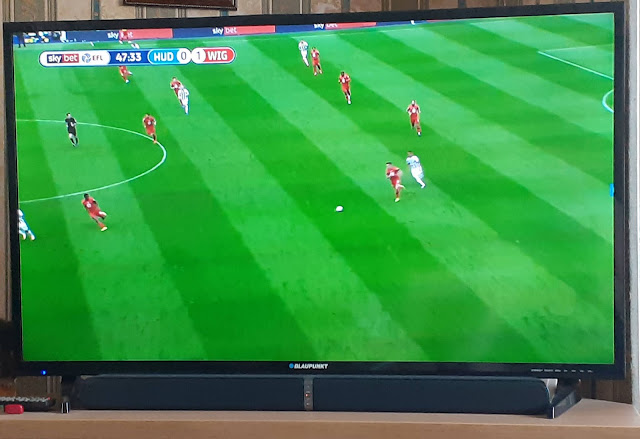
Saturday 20th June saw football ‘return’ – at least for me. My team,
Wigan Athletic, are currently involved in a 7/8 team battle to avoid the
Championship relegation zone, with the promotion places similarly being
competitive.
With so much money at stake, the league was always going to
continue in some form – aside from the obvious windfall clubs will get by
winning promotion to the Premier League, the drop in TV money from The
Championship to League One is massive too (which explains why League One and Two were
ended with Points-Per-Game).
With the rest of the season being played behind closed
doors, this leaves season ticket holders somewhat short. As a season ticket
holder at Wigan, I was presented with 3 different options instead of being
able to attend in person:
A pro-rata refund.
Put credit towards next season’s season ticket.
‘Donate’ the remaining credit to the club for a
streaming pass for the remaining 9 games.
As I’ve already spent the money, I’ve missed watching games
and I’ve got everything I need to stream it on the telly – I chose the latter
option. It offered great value; I get to watch the remaining 9 games (instead
of the 5 home games I would have been entitled to) and the club keeps the
money, so everyone’s a winner. I should say that this was the best option for
me – in times like this where money is scarce, it’s understandable that people
would want refunds.
Hooking up my laptop to my telly with an HDMI cable, I got
settled for ‘the new normal’ watching football – to be honest, I didn’t notice
much difference. Our match was a particularly important one at Huddersfield,
who are also hovering around the bottom end of the table. Obviously, no crowd
being there made for a weird atmosphere, but I found that after 10 minutes of
watching the game, I didn’t really notice, as I concentrated on the play.
The most interesting aspect of these remaining games will be
to see how the home teams get on without a home crowd there to cheer them on
(and to sway the referee, which we all know doesn’t happen…) – and there
certainly were some interesting results in The Championship, where only TWO
home sides managed to win (Cardiff and Blackburn, who we are hosting next
week, coincidentally). Winning 2-0, Wigan continued their pre-lockdown form; it
took a while for them to get going, but once they were able to get their pressing game
sorted, the team controlled the match from then on.
Huddersfield looked a
little tired if truth be told – despite making the five substitutes (the rule
brought in for these remaining games) they still had a player going down with
cramp late on. Whilst the players have been in training for a couple of weeks,
they’ve essentially had to fit in a full pre-season in that time, with only one-or-two
friendly matches for practice. You can’t get up to speed physically in that time.
Overall, the streaming service was great – full HD, no
connection issues or anything. Apparently, supporters of teams who use the
iFollow service had connection problems at kick-off – the server provider not
making concessions for the sheer volume of people who would have been
streaming. Although Wigan’s feed is provided by iFollow, it’s hosted on another
server – so it was fine for me and the millions of other Wigan fans across the
globe!
The issue with the atmosphere at these empty grounds is a
sticking point for many – as I said, I don’t mind it, but others said they
found it a hard watch. The Premier League games have seen crowd noise pumped
into the grounds to make up for it – I don’t like it, to be honest. It’s been
designed to ‘create familiar surroundings’ for the players and the people
watching back home. The problem is that I know it’s fake and the players know
it’s fake – wouldn’t that work to provide a negative
effect? I even watched one game where it was clear someone was in charge of a
soundboard and had to do the ‘ooohs’ and ‘aaahs’ whenever there’s a chance, but
unless they’re psychic, it’s always going be a couple of seconds behind.
Another thing clubs (including Wigan) have done is to have
cardboard cut-outs of supporters (and certain notorious people) at grounds –
again, I’m not a fan (it sounds a bit ridiculous on the face of it), but as
they’re raising a bit of money for the clubs who’ve had their income streams
hit, I’m more willing to let it slide. Our cardboard cut-outs cost £20 for the
remaining games, so I’m currently racking my brains of a notorious celebrity
that will get through the censors!
The good thing about our teams playing behind closed doors is
that it shines a spotlight on how important supporters in a match-environment –
hopefully this dystopian future where we all watch on television in the homes
we live, work and play in 24/7 won’t happen now, as we’ve experienced what it’s
like? Maybe the importance of supporters will be shown some appreciation when games do resume with cheaper ticket prices…okay,
I concede that’s less likely than the dystopian future!
So whilst this new normal will do for now, I hope we get
back to being in stadiums before long – it isn’t just the matches we all miss,
it’s everything we do before and after; the meeting up with friends/family,
travelling, going to pubs, exploring new places, meeting new people…you can’t
recreate that with streaming, WhatsApp or Twitter.
In a new series, the
blog is going to feature interviews with a range of different people who use
their love of football to explore other passions. Whether that’s scratching a
particular creative itch, visiting new places, building a career, connecting
with others, delving into history…there’s many great stories out there that sum
up what ‘the beautiful game’ can provide people outside of the 90 minutes – so I’m aiming to uncover as many of these personal tales as
possible.
In this opening
Q&A, I was delighted to chat with Anders Johansen – a groundhopper from
Norway who has become notable on the English scene, visiting 526 grounds
throughout the country (and plenty more across the rest of the UK too). He’s
been featured in articles on BBC News, on many of the websites of the clubs he’s been to and has a strong
following on Twitter. Always looking to explore new places, he’s constantly planning
his trips to England – it literally took a global pandemic to pause his total!
Anders has made use of his trips, writing travel guides – ‘Engelsk fotball: Lagene, banene, pubene’(English football: teams, courses [directions], pubs), which caters for a growing
market of football-mad Norwegians taking ‘football holidays’ in the UK. Interestingly
though, it isn’t the glamour of the Premier League that attracts many of these
Vikings, who are simply looking to experience what British football is truly about – as you’re about to
find out.
I asked Anders about his groundhopping, his best
experiences, what he thinks about modern football and if Norway, without a
major finals tournament appearance in 20 years, can qualify for Euro 2020 (now
taking place in 2021, of course!)
Hi Anders, when did
your passion for groundhopping start?
I'd say it was something that happened over
a bit of time. At first I was happy flying over watching Reading, then sit in
the pubs waiting for the next Reading game or fly back home. At some point I
decided I might as well watch some other games on days Reading weren't playing.
However, it didn't really take off until a few years later, and I'd say my
first proper groundhopping trip was over Christmas and New Year’s 2008/2009.
Then things really started picking up once I went to a couple of non-league
games in 2010 and got the taste for it. At that time I was becoming
disillusioned with football at the top levels, feeling it had been reduced to a
business, but I now fell in love with the game again and never looked back.
Many people in Norway have a great love for
British football; not just the Premier League, but all the clubs in England's
professional leagues seem to have a Norwegian supporters club - what's the
appeal behind a Norwegian following, say, a struggling club in League Two?
The Norwegian’s fascination with English
football can probably be quite easily explained. NRK (Norway's equivalent to
BBC) showed, from November 1969 onwards, live football from one of the Saturday
matches in England. A whole generation or two grew up watching English football
as this soon became an institution and the TV highlight of the week. The
weekend's game was what we talked about in school, and the stars of the English
games became the heroes, collecting and swapping cards and stickers of
them.
As for the appeal behind lower league clubs
as well, that's a harder one to answer. English football in general has a big
appeal here, but I can't really explain why someone in Norway chooses to
support the likes of Exeter City, Hartlepool United or even Chippenham Town.
Maybe a desire to support someone that not "everyone else" supports?
For some clubs now in the lower divisions, it could be a case of them having
been in the top flight in the past and shown on Norwegian telly at the time; some
people might have liked their kits or something. Most people in Norway will of
course support the big clubs, but other clubs now outside the top flight have a
good following. However it's easy to explain the amount of support for clubs
like Leeds, Forest, Derby etc, as they were big teams when most of this people
were kids watching them on telly. Some will have been on a trip to England,
taking in a game somewhere, then getting hooked on that club. But it'll be
mostly guessing on my part.
I know however, for some of the lower league
and non-league clubs, that there are people who might have supported a big club
in the past, who got fed up with the modern game and how it's been reduced to a
business; hence finding a new club to follow further down. But again, this is a
difficult one to answer.
So you’re a Reading
supporter – how did you come to be a fan, when was your first visit and what’s
your favourite memory supporting them?
In 1994, a mate and I was on a holiday in
Playa del Inglés, Gran Canaria. We ended up spending every night out with a
group of lads from Reading, and I went over to visit them the year after, just
as Reading were on their way to Wembley and the play-off final (which they lost
to Bolton after throwing away the lead).
My first visit to a Reading home game was the following season, in October 1995, when my mate Rob took me to wonderful
old Elm Park in some of the worst torrential rain I've ever experienced. They
were playing Bury in a league cup game, and the away team looked to cause an
upset when the ref stopped the game after 28 minutes with the score at 0-2. The
Bury fans were fuming, the homes fans were singing "always look on the
bright side of life", and I was hooked. On a side note, I still miss Elm
Park a lot.
As for my favourite moment supporting
Reading, the first that comes to mind is a certain Saturday back in April 2002,
when they played in the third tier. Last game of the season, it was Brentford v
Reading at Griffin Park. Reading would go up as runners-up if they managed a
draw, while Brentford would leapfrog Reading by beating them. Brentford took
the lead in the second half, but with 13 minutes remaining Jamie Cureton popped
up to score a vital equaliser. After a nervy finish, Reading got the point they
needed. Cue wild celebrations on and off the pitch.
Also fondly remember some cup games from
later years, like knocking out Liverpool etc. But sadly, as football at those
levels has changed (and the club has changed with it), I have to admit that my
interest isn't quite the same at all anymore.
One of the things I
enjoy about groundhopping is visiting unfamiliar places and being surprised at
what I find (especially the pubs!) – do you like to explore the towns and
cities you visit?
Oh yes, very much so! That's half the fun, I
think. Always plan ahead to see what there is to see and what pubs there are
there, and I always try to get there with plenty of time to spare to have a
look around and check out the pubs etc.
You’ve visited over
400 grounds in England – you once did 20 games in 3 weeks, which is incredible.
How would you explain the attraction of your hobby to someone who doesn’t know what
it’s about?
I'm actually on 526 grounds in the English
pyramid now, and hope it won't stay that way for too long. The trips have just
gotten bigger and longer over the years, but I think my most productive trip
was when I did 31 games in 24 or 25 days back in April 2017 - with the good
help of the organised groundhop in NCEL & NWCL [Northern Counties East League & North
West Counties League].
That's someone most people will probably
describe as madness, and I think you have to enjoy football to even understand
it. But I'd say it's a fantastic way to see the country. I like travelling, and
UK is my favourite country to travel in. Unlike a "normal" vacation,
my groundhopping trips have brought me to places I wouldn't have visited
otherwise. And I've made lots of good friends along the way. It's probably
harder to explain to them my fascination with football grounds.
Still, must my mates here still think I'm a
bit mad, I think.
What are your 5
favourite grounds you’ve visited?
Oh, that's a hard one. I always have a reply
right away when asked about my favourite ground, but picking 5 is not easy. Well,
off the top of my head now...
1) The Oval, Glentoran
It just has to be the Oval. Fantastic, classic old school football ground, just
how they should be.
2) Borough Park, Workington
Even with the old Main Stand long gone, and the classic old floodlight pylons
replaced and finally removed, Borough Park is a reminder of a time when the
club played in Football League...and when FL grounds had much more character.
3) Royal Oak, Harwich & Parkeston
That steep old stand is just wonderful, even though most of the seats were
missing on my visit back in 2014, or covered in pigeon droppings. Nice little
cover behind the goal as well. Can only imagine how great a ground that was
when it apparently had cover on all four sides.
4) Millfield, Crook Town
The Northern League once had loads of lovely grounds oozing with character. Of
those remaining, Crook Town is many people's favourite, and also mine. You can
just feel the history walking up the steps and looking out over the pitch, with
the characteristic main stand on your left.
5) The Recreation Ground, Aldershot Town
If I have to pick a favourite ground from the current top 5 levels of the
English pyramid, this will be it, no doubt. Apart from the pre-fabricated,
little stand put in at the end near the entrance, it's like time's stood still
at the Recreation Ground. The East Bank is just something else, with its
barrel-shaped roof and big terrace. Main Stand looks great as well. Shame there
aren't any grounds like this left in the Football League (where my current
favourite would probably have to be Carlisle United btw).
On a different night, maybe I would've ended up including one or two others,
but there are so many great grounds to choose from. And I didn't even include
old Elm Park, as I focused on grounds still there. Other grounds worth a
mention are Bath City, Boston United, Hastings United, Falmouth Town...I could
go on and on. And from Scotland there are great contenders in the likes of Ayr
United, Queen of the South, Morton, Pollok, Cambuslang Rangers, Johnston Burgh, Fraserburgh
etc. But have to stop somewhere…moving on!
You’ve commented that
you’re not particularly fond of ‘modern’ stadiums – what’s your main issue with
them?
While they are probably great in a
functional way, as well as new and modern with 'better
facilities', I find them lacking the character of the older classic grounds.
They're often a dull plastic bowl, I think. And of course, for the all seater
ones, I miss the terracing. I see the point that some people prefer them as
they're more comfortable with better facilities. But if I wanted to be comfy,
I'd watch the game from my sofa. Also, many of them are built miles out of
town. Not a fan!
In non-league they won't be plastic bowls, but here I think they'll often be
uncharming complex type grounds...often with a plastic pitch, which is also
something I hate with a passion (it's one of the main reasons Norway is perhaps
still my least favourite country to groundhop in). But each to their own.
Following on from
that, how important do you think it is for professional clubs that stadiums are
built in the communities they represent?
The short answer is: very important. Not the
biggest issue for me anymore as most my games these days are in non-league. But
of course, much better when grounds are in the community and walk to the
ground, rather than miles out of town needing a shuttle service (if there is
one) or taxi. A nightmare getting back to catch your train after an evening
game at some of these places. And then there's the possible impact of local
pubs etc in the town centre.
The Premier League
has been criticised for a long time for valuing profits over supporters and the
communities they’re based in – is this just a problem in England, or is this
something that’s common across Europe?
You'd be surprised by how little I actually
follow top-level football these days. The only time I watch it is if I'm at a
game watching it live. I very rarely watch football on TV, and the main reason
I even keep somewhat update on results here and there now is my betting.
But I'd say the PL is probably the best
example of this. When the likes of Manchester United and Manchester City fly
across the world to play a friendly against each other (even having cities bid
and pay millions to get them there), it's utter madness as far as I'm
concerned. We've already seen English cup draws conducted on Chinese time to
accommodate the Asian sponsors and the markets there [The EFL Cup], and it's probably just a matter of time before we'll see English
clubs go to other continents to play each other in domestic competitions. Never
mind local season ticket holders who have supported the club all their lives.
Think I read something about the Spanish
league already planning something like this, so they might be just as bad. But
naturally, it's probably worse in the bigger leagues. Seems to me we're seeing
a tendency in more and more leagues, where "Champions" League/Europa League money etc has resulted in a league where the same 2-3 clubs keep
winning year after year, the financial gap between them and the rest increasing
every year. In Norway, Rosenborg benefitted from this in the 1990s and ended up
winning 13 seasons in a row, causing many to lose interest. Still, it's not
come to the point here where the clubs seem to value profit over supporters and
the community, but that's probably just because the Norwegian league is a small
league compared to the likes of PL, with MUCH less money. They know they can't
compete with English, German, Spanish and Italian clubs on the Asian to
American markets anyway, so this doesn't seem to be an issue at all here yet.
And finally…how do
you rate Norway’s chances of qualifying for next summer’s Euro 2020? They’ve
not been to a major tournament for many years but with Erling Håland smashing
in goals for Dortmund, confidence must be high?
I think the future looks brighter than in a
very long time for Norway. They've got a squad with several young, talented
players, and I think the postponement of Euro 2020 can even work to their
advantage, should they qualify. As for Erling Braut Haaland, I don't think he's
actually scored a goal yet at senior level for the national team. But he's only
had a couple of games still, and no doubt he's had a big breakthrough,
so it'll obviously just be a matter of time. He'll be important in years
to come. I think the Serbia game can be tough, and Mitrovic the danger man, but
feel Norway have a good chance. Should they win, it's either Scotland or
Israel, and I think Norway would be slight favourites against the Scots and
bigger favourites against Israel. Norway with home games as well (unless they
decide to change that somehow).
But as I don't really follow the Norway
national team that closely, I took the liberty of asking another Norwegian
groundhopper about this as well. Stig-André Lipper has the blog paabortebane.no,
and follow the national team as well as Norwegian team Strømsgodset. He had
this to say:
He seems to agree with what I said, and believe Haaland will indeed be a key
player up front. However, he points out that the Norway team will be more than
just him. Ajer is a rock in the back 4, Ødegaard is already class in the
midfield, where Sander Berge also will only get better. And up front, Norway is
starting to become spoilt for choice for a change. Haaland, King, Sørloth…he
thinks the Serbia game is 50/50, and reckon the Norway would be slight
favourites in a home game v Scotland, while they should beat Israel. All in
all, he's positive.
Massive thanks to Anders for answering my questions (and the images featured!)
– here’s hoping we all get to return to matches as soon as possible!
Set in the early days of association football, the series
tells the story of the working class strive to topple their upper-class
opponents to win the FA Cup. Interwoven with the personal and professional
struggles of real and fictional people, it was always going to distort,
amalgamate and make-up plot elements.
I’ve covered the major points here; there are other slight
inaccuracies, but these are either not integral to the story or they’re
extremely nitpicky – I wish to entertain and inform, rather than inform and
send you to sleep. (There will be spoilers, by the way, so unless you’ve
already seen it or aren’t’ particularly bothered about being spoiled, stop
reading now – save this article in your bookmarks for later, obviously).
So, that’s the warm-up done, let’s kick-off!
How True-To-Life Was ‘The English Game’?
Two Blackburn’s
The major inaccuracy of the series was Fergus Suter
captaining ‘Blackburn’ to the FA Cup win, becoming the first-working class team
to lift the trophy. The Blackburn team is, in fact, a composite of Blackburn Rovers and
Blackburn Olympic – and it was Olympic who were the first working-class team to
win the cup in 1883. Suter signed for Blackburn Rovers in 1880 and did go on to
lift the cup with them in 1884 (the first of three final wins; none against
upper-class sides) – however, he was not part of that Olympic team, so the
drama created the composite instead.
Intriguingly, both Blackburn sides wore light blue at the
time – for some reason (possibly to have a clear distinction from the Old
Etonians’ own light blue shirts), the Blackburn club in this series wore
claret.
Three Ties
The opening episode portrays the Fifth Round tie between the
Old Etonians and Darwen in 1879 – the match ending in a 5-5 draw. A major
contention point between the two sides was that the Etonians settled for a
replay, which Darwen weren’t happy with – believing themselves on top in the
play, they wanted to finish the tie with extra time (the prospect of travelling
down south again for a replay was another contention point). The drama then
portrays the Etonians winning the second match comfortably. In fact, the tie
went to a second replay after a 2-2 draw, with the third being a 6-2 win for
the Etonians – they would go on to lift the cup that year.
Cup Conquerors?
The narrative portrays the Old Etonians as the dominant side
of the era – in fact, they hadn’t won the cup at the start of the series and
would *only* go on to add a second FA Cup win in 1882. They did, however,
finish as runners-up on four other occasions – the last being the loss to
Blackburn Olympic in 1883.
The portrayal of the side being dominant is possibly a
device to tell the viewer of the supremacy of upper-class teams at the time –
Arthur Kinnaird had won the cup three times with Wanderers before he founded
the Old Etonians side. Kinnaird appeared in a total of nine FA Cup Finals – the
most of any other player to date.
No Greater Love
One of the series’ closest relationships was that between
Suter and his teammate, Jimmy Love (played by James Harkness). The story tells us that Love followed Suter
to Darwen and later, Blackburn. Jimmy fits in well with the community, finding
love (fulfilling his surname), but sadly ends up breaking his leg in his first
match for Blackburn (against Darwen) and his playing career is seemingly over.
In reality, it was Suter who followed Love down from their former club, Partick
(not to be confused with Partick Thistle), Love never played in a competitive match for any Blackburn club and by the time his friend won the
FA Cup in 1883, Jimmy was dead.
In The English Game, as a result of his broken leg, Jimmy finds work in a former
teammate’s shirt-making factory. This didn’t happen; he left Darwen after a
year and joined the Royal Marines. The reason for his departure and subsequent
joining of the Navy seems to be linked to his reason for moving to England in
the first place – a warrant was out of his arrest in Scotland over his
non-attendance of a bankruptcy hearing after his cleaning business racked up
debts.His skills as a footballer offered a route out – he was recruited by
the ambitious Darwen and as a result, he became (arguably) the world’s first
professional footballer.
After participating in the bombardment and occupation of
Ismailia, Egypt, in September 1882, Jimmy Love fell ill with enteric fever and
died, aged just 24. He was buried in Tel-el-Kebir cemetery and has also been
commemorated on a Royal Marine memorial in Rochester Cathedral. (For more
information on Jimmy Love and the differences from his portrayal in The English
Game, check out this
great article on the Scottish Sport History website).
The Founder
William Kirkham, a Darwen native, was the link between the
Lancashire mill town and Partick. Working in the area, he helped to found
Partick FC before returning home and having a hand in the development of the
local club. It’s said that he was instrumental in bringing down several players
from Patrick – first Jimmy Love and then Fergus Suter. In the series, their
professionalism is covered up by them working in a cotton mill, whereas in
reality, they were both stonemasons and their reason for chucking in the trade
shortly after arriving in Lancashire was that ‘English stone was too difficult
to work’.
There is no mention of Kirkham in the series and it seems
his role is being played by James Walsh, the owner of the cotton mill that
‘employs’ Suter and Love, and is the financer behind the team.
The Next Generation
A major storyline that runs throughout the series is Arthur
Kinnaird’s relationship with his wife, more specifically their struggle to have
children. After suffering a miscarriage early on, Alma Kinnaird (Charlotte Hope) goes on an emotional journey that makes her question her role in
the family and whether she is of use if her ‘raison d’etre’ to create heirs for
this aristocratic family doesn’t exist. The latter episodes see her getting involved with a women’s refuge and the questionable practice of an orphanage
service that sells children off.
This was a total invention – the layering of a domestic
storyline that wouldn’t look out of place in the series creator, Julian Fellowes’
Downton Abbey series. In reality, the Kinnairds had no such problems conceiving
children – their first child was born in 1876, several years before the events depicted
in the series. Over the next 25 years, they went on to have six other children,
most of whom would survive into adulthood (which wasn’t a given in those days,
by any means).
Reason For Leaving
One of the more controversial meddlings with history was Suter’s
reason for moving from Glasgow. After keeping a lid on it for a couple of episodes,
it’s eventually revealed that he took up the offer from Darwen to get away from
a drunken, abusive father so he could earn enough money to bring his mother and
sisters down from Scotland. This has no basis in fact and like the Kinnaird’s
struggle to have children, is a complete bastardisation of history. Interestingly,
there’s no mention of Suter’s brother, Edward – who would go on to follow him
to England and turn out for Darwen Football Club himself.
I was left thinking, especially considering the other inaccuracies
outlined here, that it would have been better to create fictional or composite
characters, rather than distort and besmirch real people just to provide the narrative
with some motivation. I’ve no doubt that representing history in drama can be
difficult; the reality is that even some of the most action-packed events of
the past won’t make for good drama, but I think we have a moral responsibility
to uphold the characters of the peoples and events that preceded us. The events
depicted are real, some of the people represented are not – you can still
provide people with a historical look at an event (and even some of the main
players within it), without necessarily having to change motivations or backstories. This was the main reason the series didn't hit home for me.
With the ongoing situation with the COVID-19 virus growing
increasingly severe by each passing day (virtually placing people on lockdown
in their own homes), the Football Association have taken the decision to nulland void the 2019-20 season for all non-league teams in steps 3 and below, as well as the
women’s leagues below The Championship.
Whilst there’s obviously more than football to worry about
with this emergency, with nothing else to do but stay inside for most people,
it’s not really a surprise there’s been much speculation on the status of the
2019-20 season.
It’s the haste in which the FA have taken the decision to
cancel the non-league season that has caught many by surprise – as of yet,
there is no firm idea of what will happen with club football at the top levels
of the game (the consensus is that the Premier League and The Football League
will resume in the summer), which makes the decision to cancel the non-league
football season now all the more perplexing.
Why Has The Non-League Season Been Cancelled?
It’s important to acknowledge what a difficult decision the
FA faced – there are thousands of clubs that make up the leagues below step 2
of the non-league pyramid and wiping all those results from the records must
have been a result of a great amount of deliberation.
But let’s not kid ourselves here; money is the biggest
driver in most decisions in football and it’s no coincidence that the part-time
leagues were the first to fall. It’s not just the television deals and
sponsorships that the professional club garner that make deciding what to do
with their seasons more difficult – but also for the fact they’re able to
employ vast legal teams to challenge any decision they may find unfavourable.
Also, cancelling the season now provides leagues with the
chance to start afresh next season – no having to reschedule fixtures and no
having to fit in 2-3 games a week to squeeze everything in. Even if football
could resume in the next few months, it’s unlikely that crowds would be allowed
back – just like how television provides lifeblood to the Premier League,
crowds are the income provider for the non-league game.
Solid enough reasons you might think, so why’s the
cancelling been seen as problematic?
The Problem With Cancelling The Football Season
The biggest issue I have with what the FA have done, is that
the decision seems to have been made too quickly – the clubs weren’t even
consulted and were taken by surprise as much as everyone else was. If you’re
making a decision that will affect the status of people, surely you would
garner a majority view before you proceed?
The problem with cancelling football at this moment is that
we’re in the backend of the season – it would have been easier to cancel it a
few weeks or months in, but many clubs only have 10 matches left. A number of
them have either already won promotion, are miles clear at the top, locked in
promotion battles – or are completely marooned at the bottom of their leagues
(somehow, I don’t think they’ll mind the season being cancelled!)
It has to be said – nulling and voiding makes a mockery of
their efforts throughout the season; all those games and goals will be wiped
off the records. For many clubs, this season could conceivably be the
difference in them grabbing the opportunity to progress, building themselves a
long-term future – or not. Many have already spent what little money they have
to upgrade their facilities to fill the grading requirements of the league
above – wiping the records for this season makes it more difficult for them to win promotion
next season, leaving them with massive bills to pay (with less income that they would have got at the level above, had they won promotion).
Although I think that ending the season may prove to be the
right decision for non-league (we’ve no idea when football may resume at all
levels), nulling and voiding was not the right way to go about it. Ending the
season as it was or using a points-per-game model is much better than
completely wiping the records, surely? I’m of the opinion in their haste to be
seen to be doing something, the FA panicked.
The Reaction To The FA Cancelling Non-League
As you might imagine, quite a lot of clubs aren’t best
pleased with the decision. South Shields, who are leading the Northern Premier
League Premier Division by 12 points, are heading a legal challenge on behalf
of clubs who want to challenge the nulling and voiding. The open letter, signed
by representatives of 66 clubs, have accused the FA of [taking the decision in]
‘needless and inexplicable haste’, [with] ‘a total lack of substantive dialogue
or consultation with affected clubs’ and [having] ‘no consensus’ with the
leagues.
I wish them all the best, although sadly, I don’t hold out
much hope – it isn’t a coincidence that the status of professional football
(which includes many clubs in the National Leagues) is still up in the air.
As mentioned, these clubs and leagues have the resources to make more of a challenge if they
deem they’re being handed a raw deal. This doesn’t make it right; I think all
levels of football should be treated the same because otherwise, what’s the
point in us having a competitive pyramid if everyone can't move within it?
What’s your opinion
on the non-league season being cancelled? Was it the right decision? Should the
FA have waited or ended the leagues in another way? Leave your comment below or
tweet me @pints_pies
Football is in its infancy, an amateur game dominated
by the upper class teams who invented its rules.
Arthur Kinnaird, the captain of the Old Etonians, has
played in more FA Cup Finals than any other player, and won the cup three
times.
Until 1879, no working class team had ever reached the
Quarter Finals of the FA Cup.
And so begins The English Game, Netflix’s historical
drama on the early days of association football and how it moved from the
public schools to bfellecome ‘the working class game’ it has been perceived to be
ever since. Developed by Julian Fellowes (of Downton Abbey fame), the six-part
series places its focus on two figures at opposite ends of the social scale; the
aforementioned (future Lord) Kinnaird and Fergus Suter; a Scottish player who moves
south in the pursuit of fortune.
After codifying a set of rules from the various forms of
football played throughout the country, the Football Association quickly
recognised that their game needed a ‘Challenge Cup’ to take place for its members. Initially featuring alumni from public schools, the FA Cup opened
up to include teams from working class towns and cities to broaden the game’s
appeal. Competing was difficult for the working class, however – as their
players had shift work for 6 days-a-week, travelling south to meet these
well-honed Gentlemen and beat them in a match was a difficult prospect. Then
local business owners hit upon the idea of compensating their players for loss
time so they could take time off work to practice – something that the
Gentlemen objected to, and quickly outlawed the practice…
The story initially focuses on Suter's move to the Lancashire mill town
of Darwen, and the football team's Quarter-Final clash against Kinnaird's
Old Etonians. Later, the series charts Suter's move to Darwen's rivals 'Blackburn' (a composite team of Blackburn Rovers and Blackburn Olympic) – bringing into focus the growing professionalism in the game and the northern clubs' ambition to establish themselves as leaders on the pitch.
Although the series plays fast-and-loose with some
historical facts (more about this is an upcoming blog post), the detail in
which they go to present a genuine 19th century spectacle
should be admired. Aside from things like the costumes and social etiquette
being portrayed to a tee (again, no surprise, what with it involving Julian
Fellowes), they didn’t compromise anything to present a realistic portrayal of
what the play would have looked like. I particularly enjoyed a reference to
Arthur Kinnaird’s ‘handstand’ goal celebration – which I saw at the National Football Museum recently.
Kinnaird (played by Edward Holcroft) is arguably the main
driver of the story as his outlook on life changes from someone willing to gain
an advantage any way he can, to someone who is willing to lose if it means to
play fair – as a proper Gentlemen should. Conversely, Suter (Kevin Guthrie)
is the working class hero that seems to be more of a Gentleman – despite him
wrestling with guilt at being a professional footballer, whilst his Darwen teammates get nothing. The rest of the plot
features Kinnaird and his wife’s attempts to have children, Suter’s REAL reason
for moving south, his relationships with the locals, the labour conditions of the era and the attitude of the
upper class towards their game being uspured by the working class.
As for the play presented in the series, the most successful
tactics of the time seemed to involve a ‘kick and crowd’ style – reminiscent of
what rugby union came to be. Working class teams tended to play the
‘combination game’ (a major reason being that they were not as ‘conditioned’ to
play the same way as upper class teams was because they couldn’t train anywhere near as much. So the passing lets the ball do the running, solidifying football as a quick, fast-moving, exciting game to watch). This was explained well in the series, as the
attitude towards the play of the working class was summed up by one of the Old
Etonians who said “All that absurd
passing, it’s nonsense”. How times change!
A major criticism I have of the series is that it leant too much
on placing upper class characters as villains. Whilst I do not doubt that many
of them did hold the attitude that was shown, I doubt that it
would have been as widespread as it seemed to be. Another aspect that needed focusing on
was the businessmen who bankrolled these teams – they’re portrayed as benevolent
champions of the working class when in reality, it was a means to generate
money (for most of them). Having an upper
class vs. working class conflict, with clear positions defined on both sides,
just feels a bit cartoonish.
Another issue that I’d like to pick up on is a plot point
involving Suter’s reason for moving away from Glasgow to make his money – it has
no basis in reality and simply acts as a motivation for his character. Even
though these events happened some 140 years ago, it felt somewhat disrespectful
to (potentially) besmirch the name of a real, historical family just to give a character some depth.
Overall, The English Game is a decent-enough binge-watch but
ultimately feels like a missed opportunity to explore the social impact of the
game in the depth that it deserves. It feels very-much like a cut-and-shut of the
intricacies of early football and the domestics of Downton Abbey – and it could
have easily done without the latter. Concentrating solely on the football would
have made for a great vehicle for a feature film and I hope one day that we get
to see something like it.
Amateur football is the lifeblood of the game. Whilst the
professionals play for the glory, the money and the rest of trappings that
follow, we have to pay subs just to be booted around a waterlogged pitch.
Nevertheless, despite amateur football seeming like a futile
activity for many of us, it actually helps to incubate our love of the game;
growing teamwork, friendships and sometimes, just sometimes, memories of
fleeting great play that puts us on a par with the professionals for a
spilt-second.
So no matter if you’re a seasoned veteran of the
Saturday/Sunday (or whatever day) League football, or you’re new to the game; a
wide-eyed youth with plenty of years ahead, here are some things that you will (probably)
have or will experience:
Many teams will have a BIG LAD who takes all of the
free-kicks, corners and penalties. Nobody else. Just the BIG LAD. (And woe betide
anyone who gets in his way).
There will be someone who thinks they are the lovechild of Cristiano
Ronaldo and Lionel Messi. Trying outrageous kicks, tricks and flicks until
they’re scythed down by the aforementioned BIG LAD.
There will always be some granddad playing who thinks he’s
rolling back the years by playing with youngsters, but just looks weird in a
tight-fitting shirt.
The granddad will still be better at football than you.
Many of the players will be playing under a name that isn’t
their own.
‘Medical/Physio facilities’ will consist of a bucket of
water and if you’re lucky, a bottle of supermarket own-brand deep heat.
People drinking cans and having cigs at the side of the
pitch. (As do the players at half-time).
Dogs will run onto the pitch.
The pitch will always be waterlogged in parts, no matter the
time of year.
Not all players on the team will have matching shirts.
If you’re lucky enough to get a matching shirt, it will be
caked in mud from previous games.
Two footed tackles not only happen, but are actively
encouraged.
The referee will rarely break into a sprint.
Great goalkeepers are rare.
The goalkeeper will often change with an outfield player.
The goalkeeper will often go up for a corner/take a
free-kick/penalty, regardless if their team is losing by a single goal or ten.
Managers fall into two camps: they will either think they
are Pep Guardiola and will constantly bark out incomprehensible instructions or
not be bothered and instead, will be indulging in the aforementioned cans and
cigs.
The Pep wannabes and those who aren’t bothered will be
connected by their formation of choice: 4-4-2.
A warm-up will consist of booting the ball as hard as you
can towards the goal.
You look forward to an away game – especially if it’s at
‘your ground’ (as you won’t have to put up the nets).
When you do have to put up the nets, the lack of a
stepladder will mean jumping on someone’s shoulders to get the top of the net in
place.
The referee will swear, swig and smoke just as much as the
players do.
Those were my top things you will have (probably) experienced
in amateur football. Got any of your own? Leave them in the comments below or
Tweet @pints_pies.
I think it speaks
volumes about the renitence of our country that football games have only been
suspended in times of war – indeed, the First World War was a year-old before
the football season was halted. As football is engrained in our culture, it was
used to act as a vessel of our defiance; no,
we will not be cowed and change our way of life for you.
Whilst we’re not at
war with any other nation today (thankfully), we are ‘at war’ with something
else – the COVID-19 virus. This new infectious disease has wreaked havoc around
the world, putting a stop to public events – including, as of yesterday, all
professional football in Britain.
Faced with nothing to
do of a weekend, many of us are lost. So I decided to play it safe; instead of
fighting people for the last pack of bog roll in the supermarket, I instead made
the 20-minute bus journey to Ashton-in-Makerfield to see Ashton Town take on
Holker Old Boys in the North West Counties League Division One North.
Now, let’s get one thing clear here – I fully support the decision
to suspend professional matches. Whilst I suspect that the decision was sealed when several players and
coaches got infected (or went into isolation), you can’t really deal
with a pandemic by having tens of thousands of people gather in one place, all
over the country. The people most at risk are the elderly or those with pre-existing
illnesses (a bit like seasonal flu – but it isn’t flu, it’s more aggressive,
and there’s no vaccine), so it’s only right that we take measures to protect
the most vulnerable – but whilst we need to take it seriously, we need to be
calm too.
My issue is that people are panicking without due cause
(it’s not like the Second World War when the prospect of a bomb dropping on
your house was real) – the aforementioned fighting-for-bog-roll isn’t a joke,
it’s actually happening. Exacerbated by the instant communications we have
these days, people are being somewhat hysterical – even if they ever have a
right to be, causing panic will only make things worse, leading to rash
decisions that sees them bulk buy groceries or worse, put people in danger
because of pure selfishness. What’s that war motto (that people/companies have
ripped off to use as memes) – Keep Calm and
Carry On? I’m even gladder that we aren’t at war with anyone but a virus
right now!
I wanted to see a match today, as I don’t know whether any
non-league games will be on in the next few weeks/months – a few I had eyed up
last night were called off this morning after clubs had spoken with each other about
the situation. Ashton Town happens to be the most local non-league side to me,
so I thought about it – and then they offered Wigan Athletic season ticket
holders free entry. I was on that bus faster than The Vengaboys.
If I were to speculate (always say that when you suspect you
might be incorrect) – one of the reasons that this particular game wasn’t
called off was due to the journey the away side were making – located in
Barrow-in-Furness some 90 miles away, it’s not really a midweek trip a team of
footballers (on expenses) would want to make after a day at work.
The decision from the Premier League and EFL to suspend
their fixtures until next month was designed to cut down on mass gatherings –
something that you don’t get in non-league football (bar the odd club in The National
League). Interestingly, having their turnstiles open today will be of benefit
for many these clubs; there are plenty of supporters without an EFL
or Premier League team to watch, so they're looking around for games to go to – swelling the gates.
Today’s match will be the first time that I’ve been to their
Edge Green Street ground to see Ashton Town – I’ve been there in previous years
to see several Wigan Athletic Charity games (including last
May’s against a Bryan Robson XI), but never to see the club itself (to my
shame). Currently, they’re just outside the promotion places in the First
Division North – a great start to the season was interrupted by postponements,
squad turnover and naturally, poor results. Their town rivals, Ashton Athletic
(whose home game was one of the postponements today), are currently in a similar
position in the division above – and whilst I wish both teams every success,
the panic buyer in me wants to see an Ashton derby at some point. Next season’s
Wigan Cup, perhaps?
With their involvement with the Latics Charity games (which
raise money for Josephs Goal), the club’s community involvement reflects the
character of their committee. Chairman, Mark Hayes, is particularly active in
the local area and just seems to *get* what a football club is and what it
should be doing for people. His day job is being the landlord of The Gerard
Arms in St. Helens (but let’s not hold that against him!), and in recent weeks has started
an initiative to get people talking by simply opening up a table in the pub for a
chat.
No booking required, no airs and graces, just turn up at
table 12 for a chat with a friendly face. Whilst, in his own words, not a qualified
counsellor, Mark understands that people just often need someone else to talk
to – we all have problems, some of us suffer worse than others, many have a support
network, and some of us don’t. As a pub landlord and non-league football club chairman, seeing and meeting the range
of people he does, I’d say he’s well qualified to be a good listener! Often, it’s that chat, kinship and guidance that people need to feel
better or take action to safeguard their mental health – something we’re going
to need more of in weeks to come (if all these virus predictions happen!)
An Ashton Town Association Football Club existed as early as
1903, joining the Second Division of the Lancashire Combination. Despite
winning promotion in their first season and stabilising at the level above, the
club struggled to fulfil fixtures towards the end of the 1910-11 season and
withdrew from the league. In 1953, Makerfield Mill FC (Makerfield being the
area that Ashton is historically a part of – hence the suffix), were formed, originally
playing in the Wigan Sunday School League, before spells in leagues in St.
Helens and Warrington.
Having been forced to move from their home at Windsor Road
in 1962 because of land development, the club sort to shape a tangible future
– renaming themselves as ‘Ashton Town AFC’ and playing at a number of grounds
(fields, basically) in the area before purchasing a plot of land off Edge Green
Street in 1964. Five years later, World Cup winner and Liverpool forward, Roger
Hunt, opened the clubhouse and a decade after that, the (present) changing
rooms were built – giving the club the means to establish themselves in
non-league football.
The motto of the club is ‘Onwards and Upwards’ – and there’s a real ambition to progress on a
couple of levels. Despite being founder members of the North West Counties
League, Ashton Town haven’t progressed beyond it; indeed, both Ashton clubs
have seen another local rival, Atherton Collieries, progress to the Northern
Premier League’s Premier Division in recent years (a promotion away from the
National League North, for those who don’t know). Their success just goes to
show that with robust organisation, a philosophy (both on and off the pitch), a
dedicated volunteer base and a good community reach, what clubs can achieve
at this level.
Edge Green Street is quite a large ground for a step 6 club;
hidden behind housing (just a minute’s walk from the bus stop – press the bell
when you turn the corner after ‘Ashton Carpets’), its official capacity is just
over 2000, but the space behind one of the goals (acting as a grassy car park)
and the left-side of the ground is quite substantial. My mind races with ideas about a Saudi
billionaire taking over the club and developing the ground into something like
Accrington’s Crown Ground or Fleetwood’s Highbury Stadium. It would establish
them as a proper local rival for Wigan Athletic; giving the fans somebody else
to send nonsensical internet abuse too, instead of Wigan rugby fans. (Actually,
thinking about what I've just said, it seems I may have the virus, after all!)
On approach to the turnstile, I spot a notice stuck to side
about the Coronavirus; advising us on best practices. I’m one of those who
thinks it’s odd that we need to be told how to wash our hands properly – having
been in many Gents toilets over the years (no, not like that), I can tell you now (Ladies), that the majority of them do not wash their hands (I do, by the
way). It's basic cleanliness – no wonder viruses are running riot.
I hummed and hawed about presenting my season ticket –
whilst it’s certainly kind of the club to offer the deal, I wouldn’t have
minded paying the fiver entry fee to support them. So I get a programme, raffle ticket and a
couple of pints instead (clearly, the idea behind the offer!) The clubhouse is pure
non-league; furniture and carpets that suggests they were bought second-hand from a working
mens club, husky chatter from the patrons about anything other than football, a television showing the English Badminton Championships, multipack
cans poured into plastic glasses – I didn’t even mind that there was no poncy beer
on sale.
I take my (now, usual) spot on the left side of the pitch,
taking a seat in the stand as it started to rain as soon as the match kicked
off. Both sides make a good start, as both have Periods of Possession (POP),
without much in the way of a clear-cut chance in the first 20-minutes or so.
There seems to be quite a few on – crowds here average around 50-70,
and there must be double that on today. I can even see a couple of fellow Latics supporters
(we don’t all know each other, contrary to popular belief, I just saw a few
with club gear on!)
After the balanced start, Ashton begin to take a hold of the
game and they have a great chance to take the lead when an attacker runs
through on goal, rounds the keeper, but he takes himself too wide and so by the
time his resulting shot is aimed at goal, a defender gets back to clear off the
line. No matter, they take the lead a few minutes later – and it’s a cracker
(in the words of Frank Carson); a well-worked move from a throw down the right
(my left) sees Jack McConville get clear of his markers, to the edge of the
area before curling the ball inside the near post.
The goal leads to a period of Ashton dominance; Holker’s
keeper has to pull off two great saves low down to keep it at 1-0. I make a dash
for the bar just before half-time which took me around his goal – his side give
away a free-kick and he doesn’t seem best pleased with his side, let’s just say
that. He was bollocking them.
The half-time beer (can of Carling – don’t judge me. They
didn’t have any Leffe) allows me to witness the raffle draw take place. Sadly,
my ticket is 13 numbers away from the first prize when a lad sat on the nearest
table to me draws it out. Then, to my excitement, the lady offers her raffle
cup to me to draw out the second prize – here’s my chance. I ended up drawing a
ticket 20 numbers away – no raffle whiskey for me to keep Covid-19 at bay!
Smarting from my defeat in the raffle, I return to my seat
(it was still raining) for the second half, a few minutes into it. My arse wasn’t
on the faded red seat for a minute when some controversy occurred – Holker are awarded
a penalty when their forward is hacked down in the area. However, there are
howls of derision from most inside Edge Green Street – pointing out that the
linesman had flagged for offside. The ref goes to talk to his assistant and
after a minute, proceeds to award the pen – much to the chagrin of those around
me.
As the green-shirted Holker man steps up to take it, a lone
shout of ‘SHIT’ was aired just as he struck the ball – and the keeper saves!
The Ashton custodian, Chris Cheetham, was named in the programme as the NWCFL
Division One North ‘Goalkeeper of the Month’ for December (showing how few
games have been played recently!) – although it wasn’t a great penalty by any
means, he still did well to dive the right way and hold onto the ball. So was
justice done with the miss or was another crime committed by one of the spectators?
I’m not getting involved!
The game grows more ‘industrial’ in action and language – a lad
in a Latics hat near me (who, all game, has been dying to get a hold of the
ball so he can throw it back), was giggling at the words ‘fucking hell’ that was
uttered by a player when the ref ignored his pleas for a free-kick. I overheard
his dad tell him ‘this is proper football’ earlier; with the pitch threatening
to turn into a mudbath and players swearing at each other within earshot, it
certainly takes me back. Thankfully, the lad got his opportunity to fag the
ball and chuck it to a player – big smile on his face. Somehow, I don’t think
he’ll forget a moment like that.
Despite some huffing and puffing from Holker (their best
chance of the second half being a shot that went just wide), Ashton hold out
for the three points. A cracking game on an otherwise odd occasion – when
football does resume, I want to make a point of visiting more – I’ve no excuse
really, what with it being 20 minutes away. Since the sad demise of Wigan Robin Park, they’re my ‘local’ non-league team, after all.
On the bus back into the centre of Ashton (it's only a mile away, but it's STILL pissing
down!), I encounter the lady who won the 2nd prize that I drew for in the raffle. Jealously
raged as I saw she was clutching her family tub of Quality Street, tightly.
I've no chance of getting one. I console myself by alighting at The Twisted
Vine alehouse to sink a few beers. Highly recommended if you’re ever in the
area, it’s simply a great microbar – it has the usual tight surroundings,
forcing people, who don’t know each other, to chat. There’s (of course) a
plethora of ales on tap, as well as bottles as part of a 'beer library' too. As
soon as I open the door, two dogs nearly knock me over. What a pub – you can’t
whack welcomes like that. It’s easy to see why it is 2019’s
CAMRA Wigan pub of the year.
So all that’s left to say is Keep Calm and Carry On. Look after those people around you and for
heaven’s sake, don’t bulk buy things from the supermarket – spread your shopping trips out so you leave stuff for others
(especially if it’s beer – we need something to get us through with no football
being on).